Breville
Breville Bambino BES450 Review (2026): Honest Take from a Working Barista
TL;DR
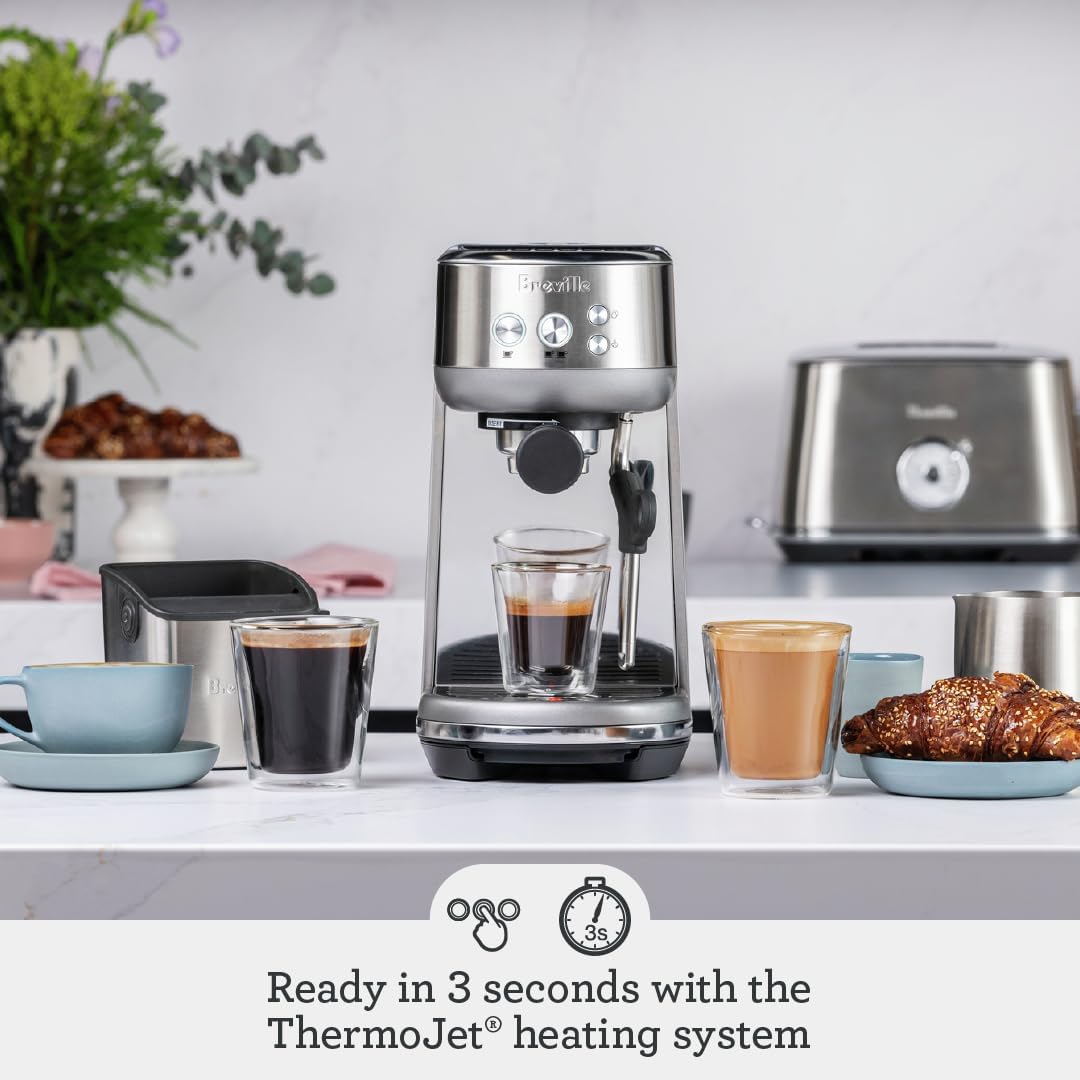
The Breville Bambino BES450 is the entry-level home espresso machine I usually recommend when somebody at the bar asks me where to start. Based on Breville's published specs and what I read across r/espresso and Home-Barista, the headline numbers seem to hold up in normal home use: a 3-second heat-up via the ThermoJet system, internal PID around 93 degrees Celsius, a 15-bar pump regulated to 9 bar at the puck, a 47 oz tank, and a 6.3-inch counter footprint. It currently sits around $249 on sale, $299 list. There are honest tradeoffs. The single ThermoJet system slows you down between shot and steam. The brew temperature is fixed, which is fine for medium-to-dark roasts and limiting for very light ones. And no machine at this price is going to save you if you skip the grinder. For most first-time home owners, this is the kind of compromise I can live with at this price.
Pros
- ThermoJet system gets to brew temperature in roughly 3 seconds (Breville's claim, generally confirmed in user reports)
- Internal PID holds brew temperature in a tight range shot after shot, which is the kind of spec you do not always see at this price
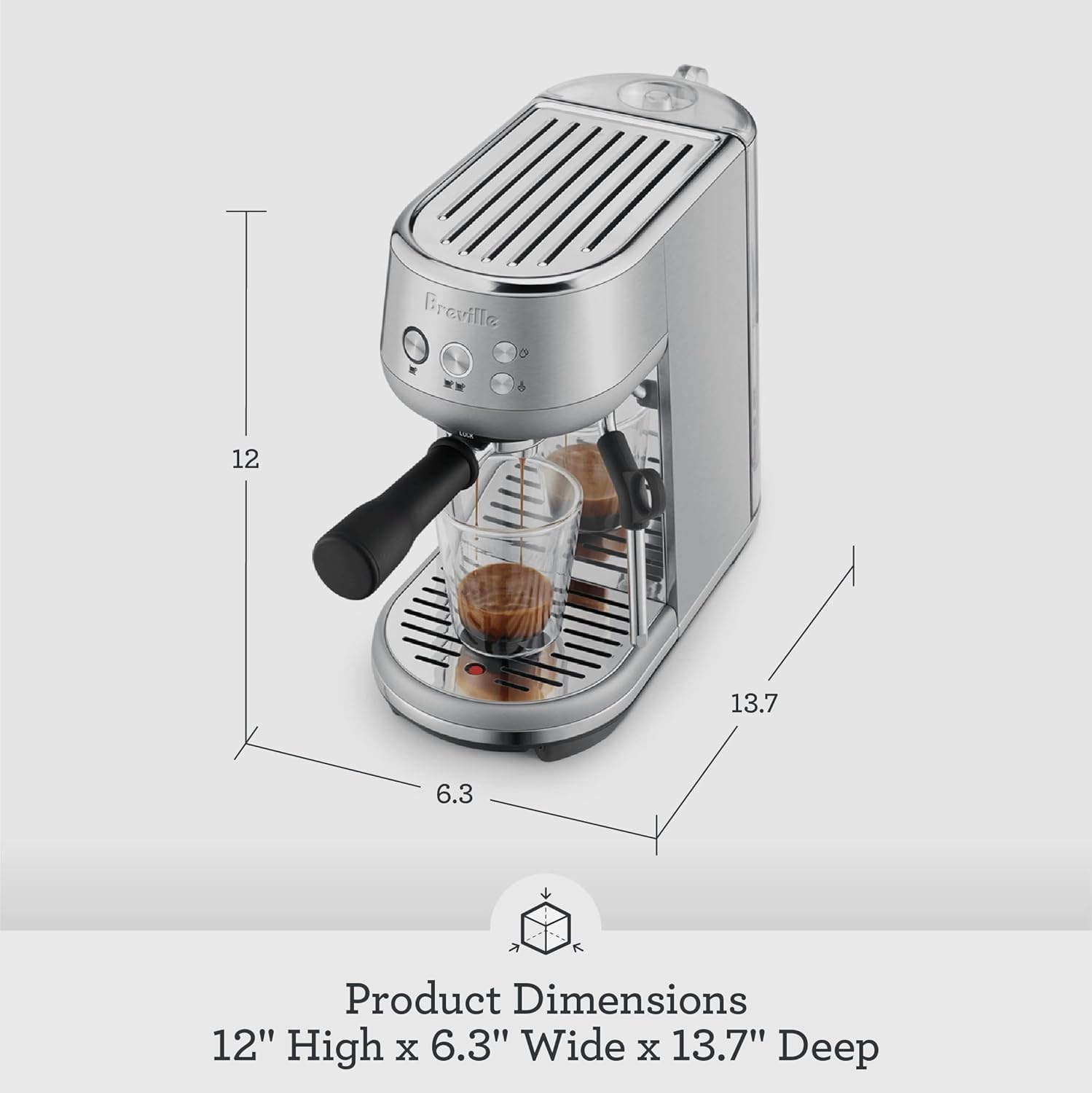
- 6.3-inch wide footprint, fits where a Gaggia Classic Pro or a Rancilio Silvia simply will not
- Manual steam wand, you actually learn to texture milk by hand instead of pressing a button
- 15-bar Italian pump regulated to 9 bar at the puck, holds steady pressure during the shot in normal home use
- Often lands around $249 on sale, $299 list, which is a strong spec sheet for the money
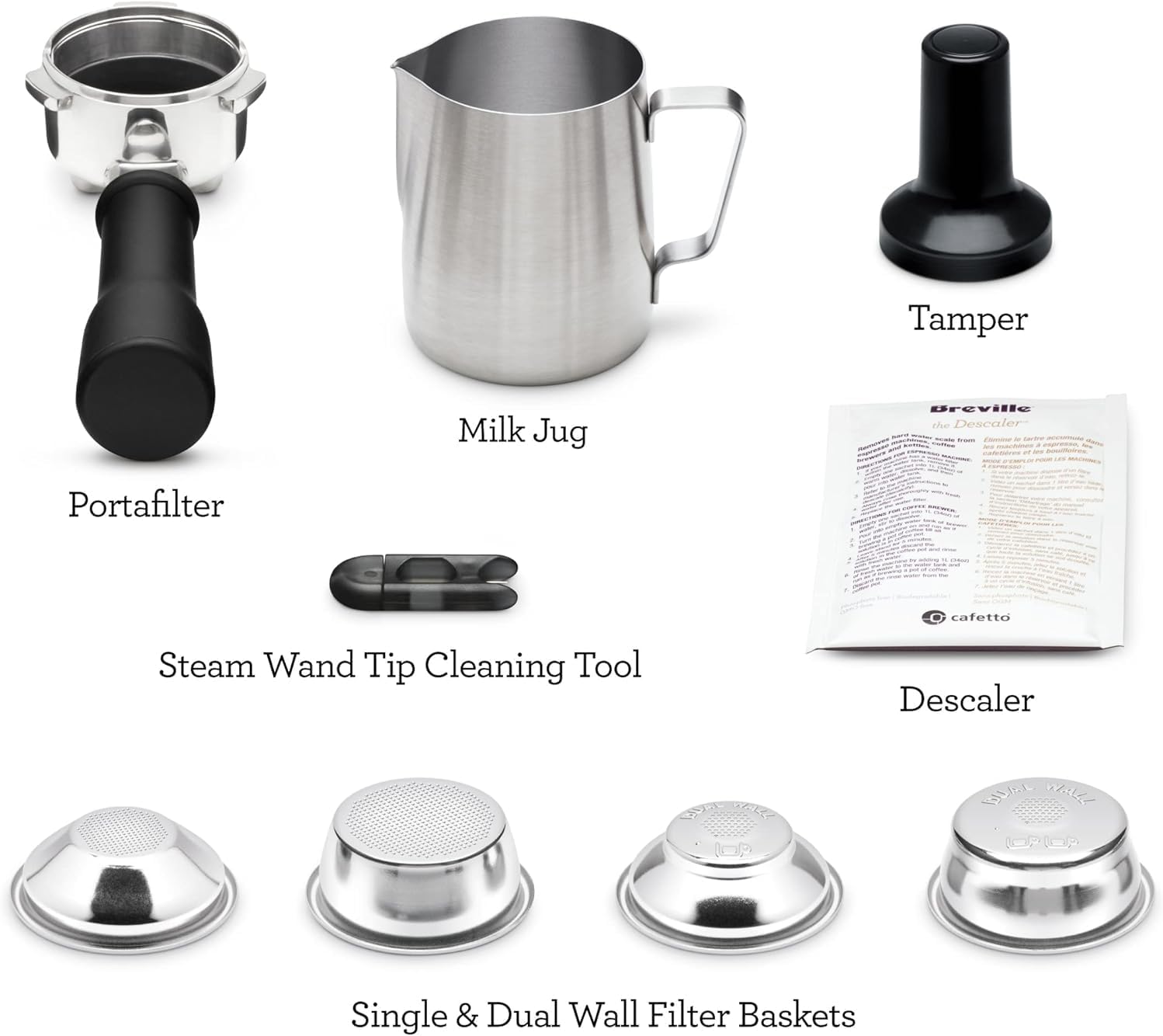
- Ships with both pressurized and non-pressurized baskets, so you can grow into real puck prep instead of being locked into training wheels
Cons
- Single ThermoJet system, so back-to-back milk drinks slow down (roughly 30 to 60 seconds between brewing and steaming, per user reports)
- Fixed brew temperature around 93 degrees Celsius, which is right for medium and dark roasts and limiting for very light roasts
- Manual wand has fixed steam pressure, no microfoam button or temperature sensor (that is the Bambino Plus)
- Plastic feel on the water tank and the steam wand handle, the chassis itself is stainless
- No built-in grinder, you should budget another $200 minimum for an espresso-capable grinder
- Breville replacement parts can be harder to source out of warranty, and repair fees are not cheap (consistent community pattern, worth knowing before you buy)
Specs
| Pump pressure | 15 bar (regulated to 9 bar at the puck, per Breville) |
|---|---|
| Heating system | ThermoJet (single thermal circuit, not a traditional boiler) |
| Tank capacity | 47 oz / 1.4 L (removable) |
| Heat-up time | About 3 seconds (Breville spec) |
| Brew temperature | Around 93 degrees Celsius (200 F), fixed (per Breville) |
| PID | Yes, internal (no visible gauge) |
| Portafilter | 54 mm, pressurized + non-pressurized baskets included |
| Steam wand | Manual single-hole (Bambino Plus is the auto-frother model) |
| Pre-infusion | Low-pressure, built in |
| Dimensions | 6.3 W x 13.7 D x 12 H inches (Amazon listing) |
| Weight | About 12 lb / 5.4 kg |
| Power | 1560 W |
| Warranty | 1 year limited |
| Made in | China (designed in Australia) |
What this machine actually is
Quick context before specs.
The Breville Bambino BES450 is a compact pump espresso machine. It currently sits around $249 on sale, $299 at list price. Stainless steel chassis, 47 oz removable water tank, fits on a 6.3 inch counter. Inside, per Breville's own description, there is a ThermoJet heating system that gets to brew temperature in about 3 seconds, an Italian-made 15-bar pump regulated to 9 bar at the puck, and an internal PID that, based on what I read in user threads, holds brew temperature around 93 degrees Celsius shot after shot. Manual steam wand for milk, single hole. That is the basic shape of it.
A note on terminology before we go further. Most places online still call the Bambino a "single boiler" machine. Strictly speaking, the ThermoJet is not a traditional boiler. It is a thermoblock-style heating system, basically a heating element wrapped around a small water reservoir. I am going to call it the ThermoJet or the heating system in this review, because that is more accurate to how it actually works. When I say "single," I mean it has one thermal circuit (you switch between brew and steam), not two like a heat exchanger or a dual-boiler machine.
I should be honest about what this review is and what it is not. I have not pulled shots on a Bambino at home. What you are reading is built from Breville's published specs, the Amazon listing for ASIN B0B1JPPG2L, public discussions on r/espresso and Home-Barista.com, and my own context as a working barista. At the shop we run a 3-group Synesso and a La Marzocco GB5. So when I evaluate a $249 home machine, I am thinking about it from two sides. One, what I pull shots on Monday through Saturday. Two, the conversations I have with customers who walk in and ask what to start with at home.
What the Bambino does well
The 3-second heat-up. Breville advertises ThermoJet as ready in roughly 3 seconds, and what I keep seeing in r/espresso and Home-Barista threads matches that. For a home setup where you walk into the kitchen at 7 AM and you want one shot before work, that matters more than people think. A Gaggia Classic Pro will have you waiting 8 to 12 minutes for the boiler to climb. The Bambino, going by user reports, is essentially ready by the time you have rinsed your portafilter.
Behind a café bar, speed matters. But repeatability matters more. That is the part of the spec sheet I think gets undersold on this machine. Breville lists internal PID temperature control on the BES450, and the user discussions I have read suggest it holds brew temp in a tight range from shot to shot. That is not the same as a $4,000 commercial machine, and I would not pretend it is. But for the price range, the consistency seems strong, and consistency is what lets a beginner actually learn instead of chasing a moving target.
The 15-bar pump number is mostly marketing. Honestly, 9 bar at the puck is what you actually want, and most pump machines over-spec on bars to sound impressive. What I care about is whether the pump holds steady pressure during a shot. Italian-made unit, low-pressure pre-infusion built in per Breville. Looks fine on paper, and the user reports back that up.
The footprint is the unsung feature for me. At 6.3 inches wide it fits in places a Gaggia (9.5 inches) or a Rancilio Silvia (9.2) will not. Three more inches matters a lot when your counter already has a toaster, a knife block, a microwave, and a bowl of plantains on it. I see this come up in customer conversations all the time. People shop for espresso machines on width.
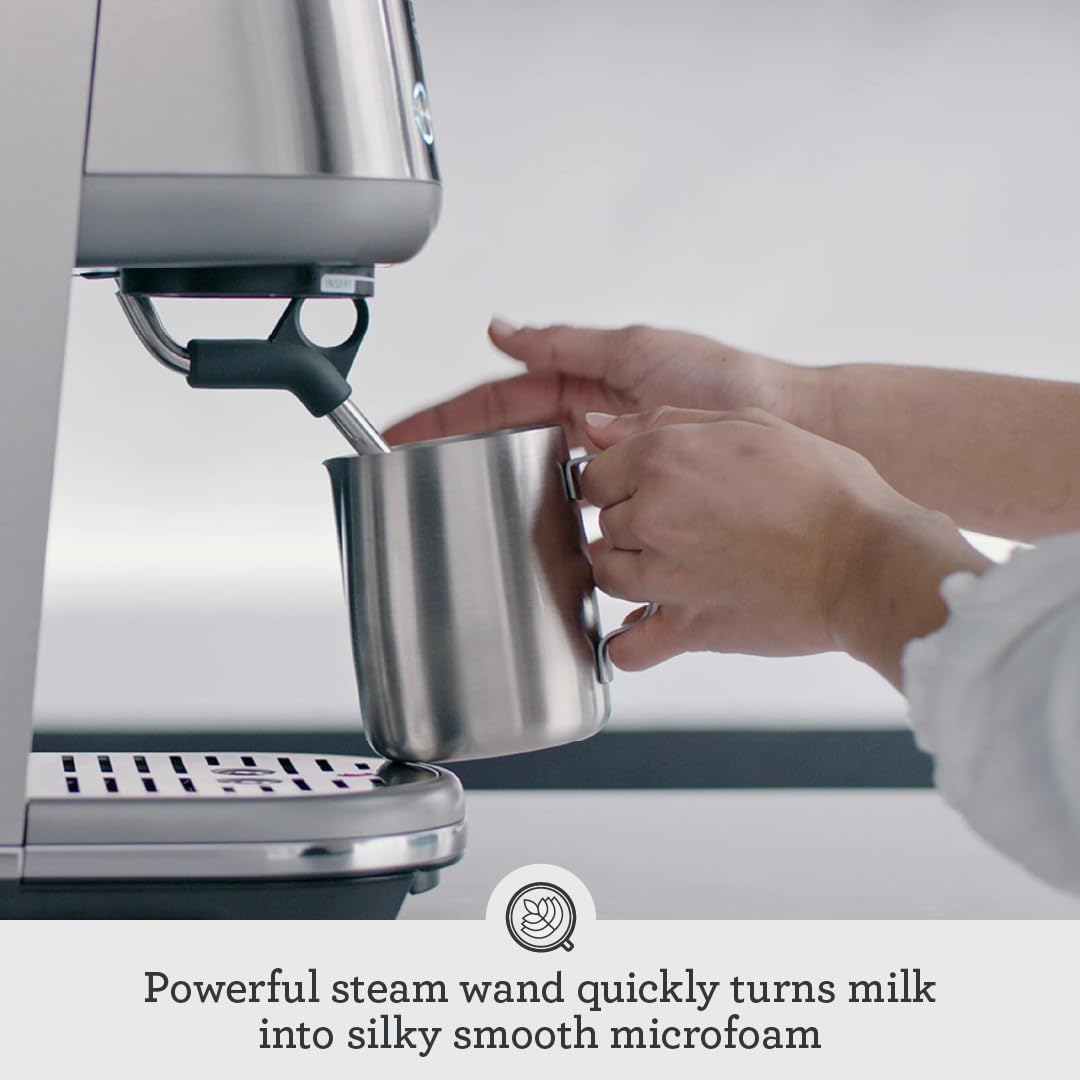
The manual steam wand is the part that seals it for me over the Plus. The Plus auto-frothes for you, which sounds great until you realize you never actually learn to texture milk. With the regular Bambino you steam by hand, the way you do on any cafe machine. Your first 5 pours come out terrible. Your next 20 are better. By pour 50 you should be getting real microfoam, and that skill is portable. If you ever upgrade to a Linea Mini or a Profitec one day, you take that knowledge with you. The Plus owner has to start over.
Where the Bambino falls short
The single ThermoJet system is the headline limitation. After pulling a shot, the heating system needs to switch from brew temperature to steam temperature, which takes roughly 30 to 60 seconds depending on who is reporting it. For one or two drinks back to back this is not a problem. For a Saturday morning where four people want cappuccinos, it gets tedious. This is the most consistent complaint I see across r/espresso and Home-Barista threads, and it is the honest tradeoff for the 3-second heat-up. You cannot have both at this price.
The brew temperature is fixed. For me, that is fine for 90% of the beans most beginners actually drink. Medium roasts, dark roasts, anything with caramel or chocolate notes. But for very light roasts that want hotter water to extract properly (think Tim Wendelboe, La Cabra, anything where the bag says "best for filter brew"), the Bambino caps out and your shots will likely taste underdeveloped. If light roasts are your thing, you are not really shopping in this segment, you are looking at a Gaggia Classic Pro with a PID mod or a Lelit Mara.
Steam pressure is decent, not prosumer-level. From the user reports I have read, stretching milk takes a couple extra seconds compared to a Rancilio Silvia or a Gaggia. You can absolutely make microfoam, but you have to commit to the technique. There is no microfoam button to bail you out.
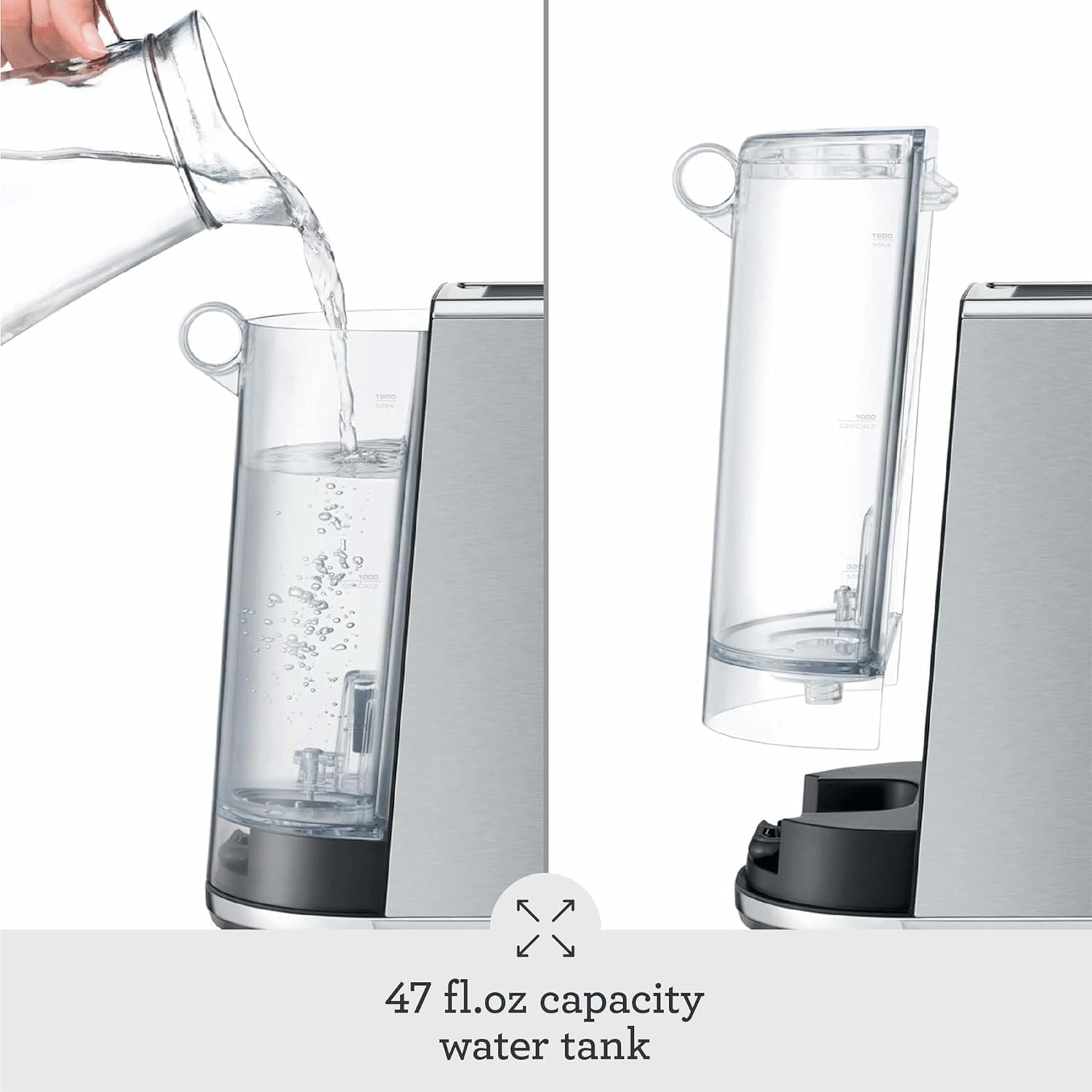
The build feels lighter at the touchpoints. The chassis is stainless steel and it looks clean. The water tank is plastic. The steam wand handle is plastic. None of this affects shot quality. It affects how the machine feels in your hand and how it survives two years of kids pulling on the steam wand.
There is one more thing I want to flag honestly, because it shows up across enough community threads to be a pattern. Breville parts are not always easy to source out of warranty, and out-of-warranty repair fees are not cheap. I would not treat that as a deal breaker at this price, but you should know it before you buy.
The pressurized baskets it ships with are training wheels. They exist to give pre-ground or coarsely ground coffee a soft landing on day one, by adding artificial back pressure so something that looks like espresso comes out. Real espresso uses non-pressurized baskets, which the Bambino also includes, thankfully. If you stick with the pressurized baskets forever, you will hit a quality ceiling fast and not understand why your friend's home setup tastes better than yours.
Who this is for
If you drink one or two espresso drinks a day, have around $250 to $300 for the machine plus another $200 for a real grinder, and you are willing to put in two to four weeks of dialing in, this is one of the cleanest entry points to home espresso under $300 right now. Pair it with a Baratza Encore ESP and a basic puck-prep kit (a WDT tool and a calibrated tamper) and within a month you will probably be making espresso that holds up against what most casual neighborhood cafes serve. Not the specialty third-wave shops doing single-origin pour-over levels of work. The average ones.
It is also right if you actually want to learn manual milk technique. The wand is forgiving enough to learn on, real enough that the technique transfers if you upgrade later.
It is also right if your kitchen is small. Most beginners underestimate how much space a 9-inch wide machine eats when they already have a toaster, a microwave, and two cutting boards in play.
Who it is not for
A few honest scenarios where I would tell you to look somewhere else.
If you want to push one button and walk away, you do not want a manual espresso machine at all. A Philips 3200 LatteGo or a similar super-automatic gives up shot quality but also gives up the learning curve. That is a real tradeoff and for some people it is the right one.
If you make three or four milk drinks back to back regularly, the single ThermoJet system is going to frustrate you. The Bambino Plus does not solve this either, same heating system. You want a heat exchanger or a dual boiler at that volume. Profitec, Lelit, Rocket. Not this segment.
If you mostly drink very light roasts that need 95 degree water, the fixed brew temperature is going to feel limiting and there is no exposed PID adjustment for you to bump it up.
If you already know you want pressure profiling, real PID with a screen, or a 58 mm portafilter ecosystem, you are out of entry-level territory. Look at Profitec, Lelit, or a used Linea Mini. The Bambino is not going to scratch that itch.
How it stacks up against alternatives
Bambino Plus BES500 is the obvious upgrade. Same chassis, same pump, same ThermoJet system, but with an auto-frother that texturizes milk for you. Around $349 on sale, $399 list. If you do not want to learn manual milk and you have the extra $100, it is worth it. If you do, save the money and get the regular Bambino.
Gaggia Classic Pro lives at around $499. Bigger footprint at 9.5 inches wide, brass boiler, manual steam wand, mod-friendly. The shot quality ceiling is higher because you can swap parts and tune it for years. The tradeoffs are a longer warmup (8 to 12 minutes vs 3 seconds), more counter space, and more setup work upfront. If you want a machine you can grow with for a decade, the Gaggia is a strong argument. If you want to be pulling shots tomorrow morning, the Bambino is the easier first step.
DeLonghi Stilosa is around $99. Cheaper, but the steam wand is mostly theatre and the build feels much lighter than the Bambino in my hand. I would not recommend it as a starter. If budget is the only constraint, I would tell you to wait until the Bambino is on sale.
Barista Express BES870XL at around $549 is essentially the Bambino with a built-in conical burr grinder. One purchase, one box, one warranty. The grinder inside is fine but not amazing, going by user discussions. If you want simplicity and you have the cash, it is a reasonable shortcut. If you can spend $249 on the Bambino plus $200 on a Baratza Encore ESP, you end up with a better grinder for the same total money and a smaller footprint. That is the tradeoff.
What I would tell a customer at the bar
Behind a café bar, when somebody asks me about home espresso, I usually run them through the same short list. So here is the version I would say to your face if you walked in tomorrow:
If you want to actually learn home espresso, get the Bambino, get the Baratza Encore ESP, and give yourself 30 days. After 30 days, you will know if espresso at home is your thing.
If you want to push a button and not think, do not buy any espresso machine. Get a super-automatic. You will be happier.
If you are going to make four cappuccinos every Saturday morning, save up another six months and buy a heat exchanger machine. The Bambino is the wrong tool for that volume and so is the Plus.
If you buy the Bambino but you grind at the supermarket or you use pre-ground coffee from a bag, do not blame the machine when the shots taste bad. The grinder is at least half of what you are tasting in espresso. Maybe more.
If you live somewhere with hard water (Miami, Phoenix, New York, most of the country honestly), descale on the high end of the schedule. The ThermoJet is sensitive to scale.
That is roughly what I tell customers. Same script every time, because the question is the same every time.
Common mistakes new Bambino owners make
The biggest one I see referenced across community threads is buying the machine and a pre-ground bag of espresso the same day. Pre-ground coffee loses freshness fast (most roasters say within a day or two of grinding), and the Bambino cannot fix that. Spend the first $200 of your post-purchase budget on a grinder before you pull a single shot. I would not overthink this, just get the Encore ESP.
Sticking with the pressurized baskets is the next one. They are included to give you a soft landing on day one, but they hide the actual flavor of the bean and the actual quality of your puck prep. Switch to the non-pressurized baskets in week 2 once you have a grinder, and you will start tasting real espresso instead of bitter water.
Skipping puck prep is a real one too. WDT, level, tamp. Three motions, takes 30 seconds total, fixes more channeling than any machine upgrade you could buy. Channeling is the single most common newbie problem on this machine, going by Home-Barista threads, and almost all of it is grinder + tamping technique, not the Bambino itself.
Not preheating is another one that gets blamed on the machine. The shot drops temperature the second it hits a cold cup or a cold portafilter, and you taste that as sour. Run a blank shot to warm the portafilter. Run hot water through the cup. Takes 15 seconds and fixes a real problem.
Descaling on the manual's slowest schedule when you have hard water. Miami water is hard. Phoenix is harder. The ThermoJet is sensitive to scale buildup, and if you stretch the descale interval, the machine starts pulling shots cold and you blame Breville instead of the calcium.
Final recommendation
Honestly, this is what I would tell a friend.
The Breville Bambino BES450 is the machine I point first-time owners to when they are willing to commit to the workflow. It is not the best espresso machine on the market. It is the best machine to learn on, in my opinion, without losing $1,000 if you find out a year from now that espresso is not for you.
For most people the question is not Bambino vs another brand. It is whether you are willing to do the work. Real home espresso means buying fresh beans every two weeks, weighing your dose with a scale, doing WDT before you tamp, and descaling on schedule. If you commit to all of that on a Bambino, the shots should be excellent for the price. If you skip those steps, no $300 machine is going to save you. Honestly, no $3,000 machine is going to save you either.
Buy the Bambino, pair it with the Baratza Encore ESP, and give yourself 30 days. If after 30 days your shots are still sour, the problem is almost never the machine. It is the grinder, the beans, the puck prep, or your patience. The Bambino is the one variable in that list that is not your fault, and at $249 on sale, it is the easiest one to get right.
This is the kind of compromise I can live with at this price.
Related on GrindCircle
Frequently Asked Questions
Is the Breville Bambino BES450 a good beginner espresso machine?
For most people, yes. When customers ask me at the bar what to start with, this is usually the kind of machine I point them toward. Based on Breville's specs and what I see referenced in r/espresso and Home-Barista threads, it heats up in about 3 seconds, has internal PID temperature control, a 15-bar pump regulated to 9 bar at the puck, and a manual steam wand that teaches you actual milk technique. The honest catch is the learning curve. Plan on two to four weeks of trial and error before your shots stop tasting sour or watery. If your goal is to learn home espresso without spending $1,000, this is where I would start.
Bambino vs Bambino Plus, which one should I buy?
Same chassis, same pump, same ThermoJet system. The regular Bambino BES450 has a manual steam wand and runs around $249 on sale. The Bambino Plus BES500 adds an auto-frother that texturizes milk for you with a button press and lets you set a target milk temperature, and it sits around $349 on sale. If you want to learn to texture milk by hand the way a barista does, the regular Bambino is the right pick. If you want one-button milk drinks at home and the extra $100 is not a big deal, get the Plus. Neither one fixes the back-to-back milk drink slowdown, both share the same heating system.
What grinder pairs well with the Breville Bambino?
Plan to spend at least $200 on a real espresso grinder. The Baratza Encore ESP is the most-recommended budget pairing, it has 40 grind settings with high-resolution adjustments in the espresso range. The Breville Smart Grinder Pro is the other common pairing, especially if you want everything from one brand. I would not skip the grinder step. The Bambino can pull good shots, but only if you give it a fresh, evenly distributed grind.
Why are my Bambino shots sour?
Three usual suspects, in this order. First, you probably did not preheat the cup or the portafilter, so the shot drops temperature the moment it hits cold metal. Run a blank shot first to warm everything up. Second, your grind might be too coarse, so water is rushing through the puck in 15 seconds instead of 25 to 30. Third, the bean might be too light a roast for the Bambino's fixed 93 degree brew temperature, light roasts want hotter water than this machine can deliver. Try a medium-dark roast first while you figure out the rest of the variables.
How long does the Breville Bambino last?
Lifespan reports vary across r/espresso and Home-Barista threads, with most owners describing multi-year ownership before steam wand or pump issues appear. The specifics depend heavily on water hardness, descaling cadence, and how many drinks per day. I would not promise you a specific number. Breville offers a 1-year limited warranty on the BES450. Two things to know honestly: replacement parts can be harder to source than for a Gaggia or a Rancilio, and out-of-warranty repair fees are not cheap. To extend the machine's life, descale on schedule and use filtered water. In a hard-water area like Miami, that probably means descaling more often than the manual suggests, not less.
Can the Bambino make latte art?
Yes, with limits. The manual steam wand can produce decent microfoam if you angle the wand correctly and stretch the milk in the first 3 seconds. Steam pressure is lower than on a prosumer machine, so dense microfoam takes practice. For beginner-level latte art (a heart, a tulip), it is enough once you put in the reps. For advanced rosettas and stacked tulips, you are eventually going to want more steam pressure and you will be looking at a Profitec or a Lelit, not the Bambino.
Is the Bambino worth it on sale at $249?
At $249, yes, in my opinion. You are getting a 15-bar Italian pump, internal PID, the ThermoJet heat-up, a manual steam wand, and a 47 oz tank in a 6.3-inch wide chassis. The closest competitors at that price point feel a step down in build to me. If you see it at $249 and you have the grinder budget on top, that is the buy point I would tell a friend to wait for.
This review contains Amazon affiliate links. We may earn a commission at no extra cost to you. Read the full disclosure.